
National
Analysts: Thai Border Barriers Cannot Establish Legal Occupation or Redraw International Boundary

PHNOM PENH, July 28, 2026 (KPT) – Cambodian analysts say Thailand’s construction of fences, barbed wire and other fortifications along disputed sections of the border cannot establish legal control or redraw internationally recognised boundaries, stressing that unilateral actions carry no weight under international law.
Their comments follow fresh accusations from Phnom Penh that Thai forces continue to install barriers in contested areas despite repeated diplomatic protests.
Political analyst Kin Phea said building fences in areas not jointly demarcated violates international law, bilateral treaties and mechanisms agreed by both countries.
“An international border cannot be changed by one country acting alone. Any settlement must be agreed through legal and diplomatic channels,” he said. He added that Cambodia’s formal protests serve as evidence it has never accepted Thai claims.
Another analyst, Yang Peou, said the installation of barbed wire, shipping containers and military fortifications amounted to attempts to create “facts on the ground” before the dispute is resolved.
He argued such actions disregarded treaties establishing the boundary and risked undermining regional stability.
The remarks echo government spokesman Pen Bona, who said Monday that “barbed wire and shipping containers can never replace the international border.”

He reaffirmed Cambodia’s commitment to protecting its borders under international law, including the principle of uti possidetis juris, which upholds the inviolability of established boundaries.
Cambodia’s foreign ministry recently accused Thai troops of road construction between Boundary Markers 8 and 9 in Oddar Meanchey province and installing wire between Markers 19 and 20 in Samraong City earlier this month.
Officials said the activities encroached on Cambodian territory and violated the 1904 Franco‑Siamese Convention, the 1907 Franco‑Siamese Treaty, the 2000 land boundary memorandum and commitments from the December 2025 General Border Committee meeting, which called for demarcation through the Joint Boundary Commission.
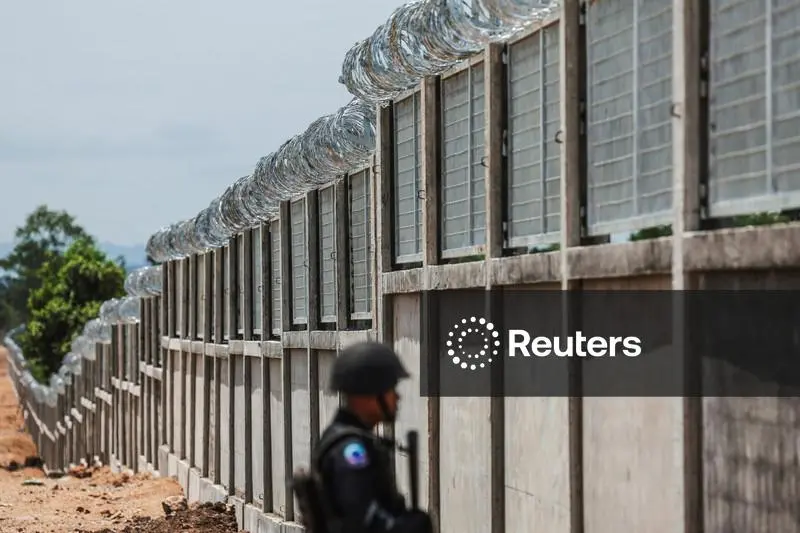
The dispute has also prolonged humanitarian impacts. Cambodia’s Ministry of Interior said on July 26 that more than 20,000 people remain displaced, including over 10,000 women and 6,000 children, seven months after the latest ceasefire took effect. At the height of last year’s conflict, more than 640,000 people were displaced.
Analysts say Cambodia’s rejection of unilateral boundary changes underscores its reliance on legal and diplomatic mechanisms to contest Thai actions.
They argue that while temporary barriers may alter conditions on the ground, they cannot establish sovereignty or redraw internationally recognised boundaries.
For Phnom Penh, maintaining diplomatic protests and invoking treaty obligations remains central to protecting its territorial integrity and reinforcing its legal position.





-
 National2 months ago
Cambodia Expands Free ID Services While Introducing Clear Fee Structure for Administrative Documents
-
 National4 weeks ago
Cambodia proposes trilateral anti‑crime liaison mechanism with Laos, Vietnam
-

 National4 weeks ago
PM Hun Manet to visit China as trade surges and investment deepens
-
 National2 months ago
Samdech Techo Hun Sen Says Cambodia Can Meet Defence Needs Through Domestic Production
-
 National3 weeks ago
Cambodia says four soldiers injured in border blast, investigation launched
-

 National4 weeks ago
Cambodia opens new distribution hub to expand market access for local businesses
-

 Economy2 months ago
Cambodia’s Labor Market Set to Add 445,000 Jobs in 2026 as Industry and Services Drive Growth
-
 Economy2 months ago
10% Tariff Proposed on Cambodian Exports as U.S. Reviews Forced Labor Concerns