Uncategorized
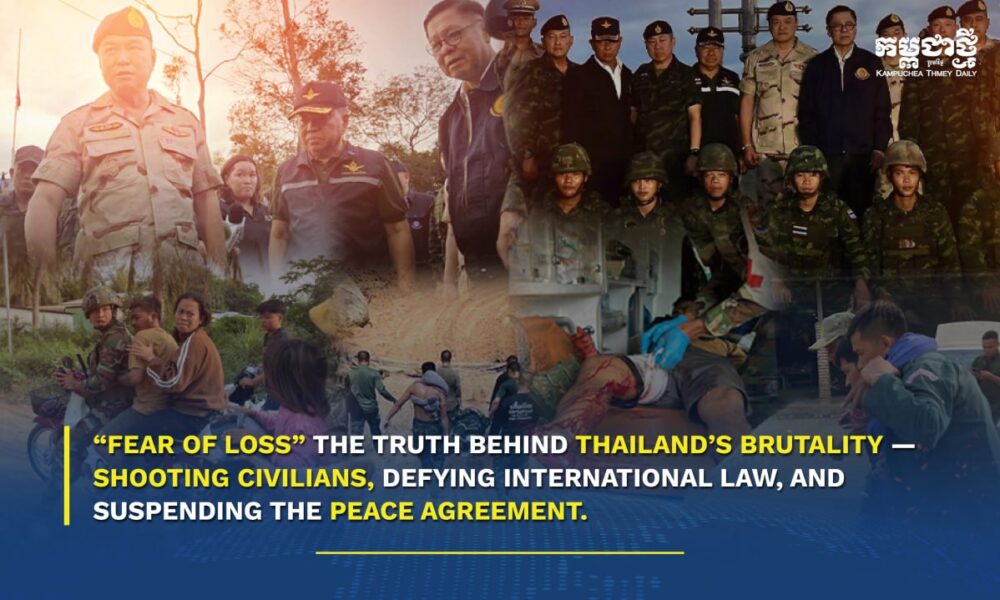
“Fear of Loss” The truth behind Thailand’s brutality — shooting civilians, defying international law, and suspending the peace agreement.
Analytical Article: Immediately after Thailand announced the suspension of the peace agreement, the fatal shooting of an innocent Cambodian villager in Prey Chan has shocked and deeply disappointed many nations around the world—especially within the ASEAN region. The incident, seen as a reckless and provocative act by the Thai military, is being regarded as a new development in Thailand’s backsliding political behavior—something even the United States did not anticipate.
The peace agreement signed on October 26, 2025, was attended by several ASEAN heads of state, notably the presence of U.S. President Donald Trump and Malaysian Prime Minister Anwar Ibrahim, who also signed as witnesses. The content of the agreement reaffirmed the strong commitment of both Cambodia and Thailand to end the decades-long border dispute stretching more than 800 kilometers.
However, the fragility of the peace agreement between the two neighboring nations was not merely caused by the Thai military’s landmine incident along the border. It conceals a much deeper story than what can be seen on the surface. Analysts claim that it stems from fear within Thailand’s political and military circles — a fear that has pushed the Cambodia–Thailand peace accord to a troubling point of collapse.
In addition to announcing the suspension of the peace agreement with Cambodia, Thailand’s failure to honor its leader’s promise to release the 18 detained Cambodian soldiers — along with the incident on the evening of November 12 that left one Cambodian civilian dead and several others injured — clearly reveals a deliberate intent to provoke conflict from a nation that disregards international norms. This behavior exposes the true character of a country that habitually disrespects international law. Furthermore, the statement made by Thailand’s interim Prime Minister, Anutin Charnvirakul, declaring that his government would no longer fear pressure from the United States, has only deepened global awareness of Thailand’s real political nature — especially in the eyes of the United States, once regarded as Thailand’s unsinkable ally.
Analysts believe both Thai politicians and military leaders have sought to create political drama to maintain their popularity, driven by underlying insecurity. This fear has ultimately led to Thailand’s unilateral decision to suspend the peace agreement — a decision whose hidden motives and military calculations will be further examined in this analytical article.
1. Domestic Pressure and Military Influence
Certainly, Thailand’s announcement to suspend the implementation of the peace agreement with Cambodia was officially linked to an incident in which two Thai soldiers were injured by a landmine near Cambodia’s Preah Vihear temple area. However, analysts argue that the landmine issue alone could not have prompted Bangkok to halt a peace accord that had been carefully crafted under U.S. mediation. Meanwhile, the incident has been repeatedly politicized and debated, as observers monitoring the peace process suggest it may have been a deliberate provocation by certain Thai political and military figures rather than a mere accident.
Analysts have pointed out Thailand’s unilateral suspension of peace accord is closely linked to issues of national pride and face, particularly within the Thai military establishment. This observation aligns with the remarks of Paul Chambers, an American political scientist specializing in Thai’s political — who himself was once targeted by Thai authorities for allegedly insulting the monarchy noted in his research “the Thai military sees itself as the ultimate guardian of the nation.” whenever the government faces questions or may threaten national prestige — whether from domestic issue or foreign interference — “the military tends to step forward to respond.”
In this context, whenever Thailand’s political leadership appears weaker than Cambodia in the eyes of ASEAN or its Western allies, Thai military leadership perceives it as a blow to their own prestige — and, by extension, to the nation’s honor. Inevitably, they move to take measures or adopt certain strategies to restore their image and reclaim a sense of strength on the regional stage.
This situation has had a profound impact on the power dynamics within Thailand’s civilian government, creating an imbalance of authority and a constant sense of intimidation. As a result, the Thai government has often been seen as needing military support before making any major decision — especially those related to conflicts with Cambodia.
2. Regional Power Shift and the Strengthening of Cambodia–U.S. Relations
The peace agreement signed in late October significantly elevated Cambodia’s international standing. In particular, both the Phnom Penh and Washington governments announced their commitment to further strengthen their friendship and cooperation, marking a new chapter in bilateral relations.
This development has helped restore Cambodia–U.S. relations, which had experienced years of tension, to a more positive footing. Both nations are now set to reestablish joint military cooperation and expand humanitarian programs, signaling a renewed era of mutual trust and engagement.
Analysts have observed that the improving friendship between Cambodia and the United States has not pleased Thailand. On the contrary, the Bangkok government appears to feel increasingly insecure and weakened by this development.
“Washington’s policy of strengthening relations with the Phnom Penh government, after years of tension, represents a significant development.” This was stated by American scholar Catharin Dalpino.
According to a report by the U.S. broadcaster VOA, Catharin Dalpino, a Southeast Asia political geography expert at Georgetown University, noted that this is a sign of the U.S. government’s effort to reestablish ties with mainland ASEAN countries — a region that the United States recognizes as a key geopolitical area where China is rapidly expanding its influence.
The improving relations between Cambodia and the United States have clearly displeased Thailand. For many years, Thailand has been considered Washington’s key ally in mainland ASEAN. When U.S. President Donald Trump praised Cambodia for its efforts to maintain regional peace, it affected both Thai politicians and military leaders, who perceived that their own relationship with the United States was being undermined.
Furthermore, Cambodia’s growing diplomatic recognition both regionally and internationally has challenged Thailand’s prestige and influence in the region. This has caused resentment in Bangkok and is a key reason why Thailand has chosen to disregard the peace agreement, even with the United States and Malaysia serving as official witnesses.
3. Fear of Loss
As noted in the first point, national prestige is something the Thai military considers essential to protect. Experiencing repeated setbacks to Cambodia on the international diplomatic stage has intensified their anger. Beyond issues of prestige, the current situation has made Thai politicians and military leaders fearful of loss. With Cambodia increasingly gaining international support, Thailand perceives that Phnom Penh may gain a clear advantage in negotiating solutions to the border dispute.
For this reason, Thailand decided to suspend the peace agreement, creating an opportunity to control the narrative — such as in the landmine incident — and preventing the border situation from reaching a stable resolution.
Analysts view Thailand’s current actions as an attempt to remind Cambodia and the international community that no peace process can succeed without Bangkok’s participation.
4. Balancing Between the U.S. and China
Thailand is stepping into a critical geopolitical game in the ASEAN region, positioning itself between the influence of two major powers — the United States and China.
Bangkok’s concerns have grown stronger regarding the strengthening ties between Phnom Penh and Washington. Thailand’s suspension of the U.S.-witnessed peace agreement also serves to demonstrate its own intention to build closer relations with China — especially highlighted by King Maha Vajiralongkorn’s state visit to Beijing, which marks the first official trip by a Thai monarch to China in several centuries.
Thailand’s disregard for the U.S.-witnessed peace agreement, along with the Thai king’s visit to Beijing, clearly reflects Bangkok’s concern and fear in navigating its complex relationship with United States.
Supalak Ganjanakhundee, an advisor to Thailand’s House of Representatives Military Affairs Committee, stated at East Asia forum last September – Bangkok government is protecting itself by navigating between the two powerfull countries in order to maintain greater autonomy.
So when Thailand faces pressure from the United States, it must lean toward China to create balance between the two major powers.
During the conflict, China quietly acted as a mediator between Cambodia and Thailand, urging both parties to come to negotiation and patience. China’s discreet role is understood in the context that, although it is a close Ironclad friendship with Cambodia, it also maintains strong military and economic ties with Thailand.
In this situation, Thailand sees balancing between China and the United States as the right course of action, as it can reduces dependence on U.S. expectations.
5. Psychological Fear and National Prestige
The peace agreement with Cambodia not only exposed the failures of Thai diplomacy on the international stage but also contributed to a decline in confidence among Thai citizens — particularly hardline nationalists who criticize both politicians and the military for their inability to secure victory in the border conflict with Cambodia.
For this reason, Thailand’s suspension of the U.S.-witnessed peace agreement can be seen as an attempt to temper nationalist anger and demonstrate an effort to protect national prestige.
However, analysts note that both Thai politicians and military leaders are primarily acting to protect themselves amid domestic instability, which has made it difficult for the conflict with Cambodia to reach a genuinely peaceful resolution.
Professor Hunter Marston from Australian National University, a specialist in international relations in Indo-Pacific, has noted that conflicts in Southeast Asia often lead to significant insecurity rather than agression. From the perspective of ASEAN citizens — particularly in Thailand “Prestige, pride, and fear of losing face often outweigh the practical costs of peace.” He added.
For these reasons, analysts observe that the current instability along the Cambodia–Thailand border is not caused solely by territorial disputes. Rather, it is the result of a combination of factors highlighted in the analysis above.
In case, landmine incident involving Thai soldiers alone could not have affected the U.S.-witnessed peace agreement.
However, the current situation clearly reveals Thailand’s growing fear — both regionally and internationally — and shows that genuine efforts by Thai authorities to seek peace are unlikely to materialize. As a result, the peace agreement itself faces increasing fragility.
Nevertheless, this article serves solely as an analysis based on observable events and the findings of experts regarding the Cambodia–Thailand conflict. War & Weapon program hoped that the implementation of the peace agreement and the resolution of border issues can continue smoothly, ultimately fostering stability, peace, and renewed friendly borders between the two nations.

-

 National2 months ago
Cambodia Expands Free ID Services While Introducing Clear Fee Structure for Administrative Documents
-
 National3 weeks ago
Cambodia proposes trilateral anti‑crime liaison mechanism with Laos, Vietnam
-
 National2 weeks ago
PM Hun Manet to visit China as trade surges and investment deepens
-

 National2 weeks ago
Cambodia says four soldiers injured in border blast, investigation launched
-

 National1 month ago
Samdech Techo Hun Sen Says Cambodia Can Meet Defence Needs Through Domestic Production
-

 National2 weeks ago
Cambodia opens new distribution hub to expand market access for local businesses
-
 Opinion2 months ago
From Connectivity to Resilience: How Japan’s Strategic Shift Could Transform Cambodia’s Next Development Phase
-

 Economy2 months ago
Cambodia Welcomes 1 Million Tourists in Q1, But Arrivals Fall Sharply Amid Regional Pressures