Opinion
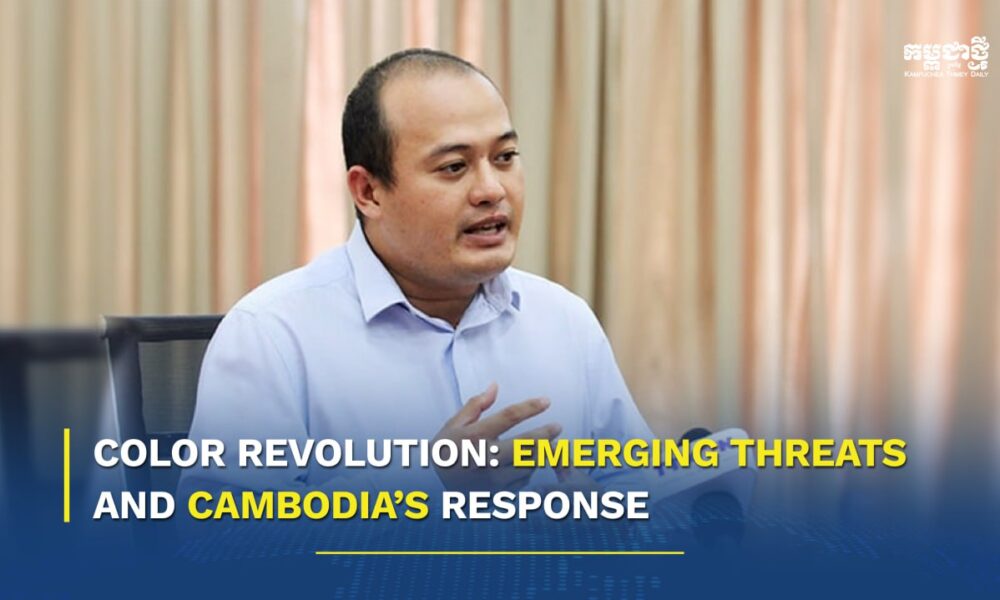
Color Revolution: Emerging Threats and Cambodia’s Response
On September 11, 2025, opposition figure Sam Rainsy expressed support for the National Resistance Council’s statement, accusing the Royal Government of Cambodia of violating the 1991 Paris Peace Agreement. His endorsement signaled attempts to establish a foreign-based movement, backed by NGOs, aimed at toppling Cambodia’s legitimate, Cambodian-led government.
A leaked letter, revealed by The Sunday Guardian on June 15, 2025, showed Mu Sochua proposing a “Bilateral Action Plan,” outlining strategies along the Cambodian-Thai border. The plan allegedly spread disinformation to mobilize opposition in contested areas such as Ta Moan and the “Triangle Area” near Cambodia, Thailand, and Laos.
It also suggested coordinating with Thailand’s Yellow Shirts to organize border operations, training for violent and non-violent protests, and conducting information campaigns. On the Cambodia side, the strategy focused on building grassroots networks against the CPP-led government, coordinating with Thai activists, and fueling nationalist sentiment to undermine the ruling family of former Prime Minister Hun Sen.
This was not the first such revelation. In November 2024, the same outlet reported links between the overseas opposition CNRP and the U.S. Civil Society Agency under former President Joe Biden, allegedly preparing a “color revolution” in Cambodia modeled after Bangladesh.
While the Royal Government has pursued peace and development, the opposition has sought to distort democracy and mobilize protests under the guise of patriotism, human rights, and democracy.
For example, Sam Rainsy encouraged protests against the CLV-DTA joint development project in August 2024, the Funan Canal project, and later supported the establishment of anti-government movements abroad. He also backed the European Parliament’s call to suspend Cambodia’s EBA trade privileges, seen as advancing foreign interests at the expense of the nation.
Repeatedly, Sam Rainsy’s attempts to incite a “color revolution” have failed, reflecting strategies imported from abroad that run counter to Cambodia’s national interests. Similar unrest in Bangladesh, Sri Lanka, and Nepal has also been linked to foreign-backed civil society groups operating under the banner of democracy and human rights.
Cambodians, shaped by painful experiences of civil war and authoritarian rule, have developed a deep appreciation for peace. National resilience is reinforced by education and awareness of the government’s state-building efforts.
The leadership of Samdech Techo Hun Sen, rooted in personal experience of foreign interference, has long prioritized peace, unity, and stability. He has repeatedly urged the public to reject color revolutions and warned that no pardon will be granted to those threatening national peace.
To safeguard sovereignty, Cambodia has passed a law allowing citizenship revocation in cases of national betrayal, extremism, terrorism, or threats to security, similar to measures in over 150 countries. This reflects the government’s commitment to confronting extremism and modern terrorism, which pose rising threats to public safety and economic stability.
Opposition figures, particularly Sam Rainsy, are accused of grave offenses, including insulting the King, destroying border posts, inciting public property destruction, and calling for armed uprisings. Their reliance on foreign alliances raises concerns about external influence undermining Cambodia’s sovereignty and stability.
Although Cambodia respects democracy and human rights under the UN Charter, opposition-aligned civil society groups and certain media outlets have exploited freedoms to serve foreign agendas. These groups attempt to provoke clashes with security forces and portray Cambodia internationally as repressive, sowing division and hatred for political gain.
The exposure of opposition plans through leaked documents is not coincidental. They highlight coordinated efforts with foreign actors to destabilize Cambodia. Citizens are therefore urged not to be misled by calls for demonstrations or “color revolutions,” but instead to draw lessons from history, value peace, and support the government’s development strategy.
Cambodians should take pride in the nation’s hard-won stability, uphold democracy in a constructive way, and prioritize the national interest above external agendas. Peace, the country’s most precious asset, must be cherished and protected.
By THONG Mengdavid, Geopolitical and International Security Analyst

-
 National2 months ago
Cambodia Expands Free ID Services While Introducing Clear Fee Structure for Administrative Documents
-
 National3 weeks ago
Cambodia proposes trilateral anti‑crime liaison mechanism with Laos, Vietnam
-
 National3 weeks ago
PM Hun Manet to visit China as trade surges and investment deepens
-
 National2 weeks ago
Cambodia says four soldiers injured in border blast, investigation launched
-
 National1 month ago
Samdech Techo Hun Sen Says Cambodia Can Meet Defence Needs Through Domestic Production
-

 National2 weeks ago
Cambodia opens new distribution hub to expand market access for local businesses
-
 Opinion2 months ago
From Connectivity to Resilience: How Japan’s Strategic Shift Could Transform Cambodia’s Next Development Phase
-
 Economy2 months ago
Cambodia Welcomes 1 Million Tourists in Q1, But Arrivals Fall Sharply Amid Regional Pressures