National
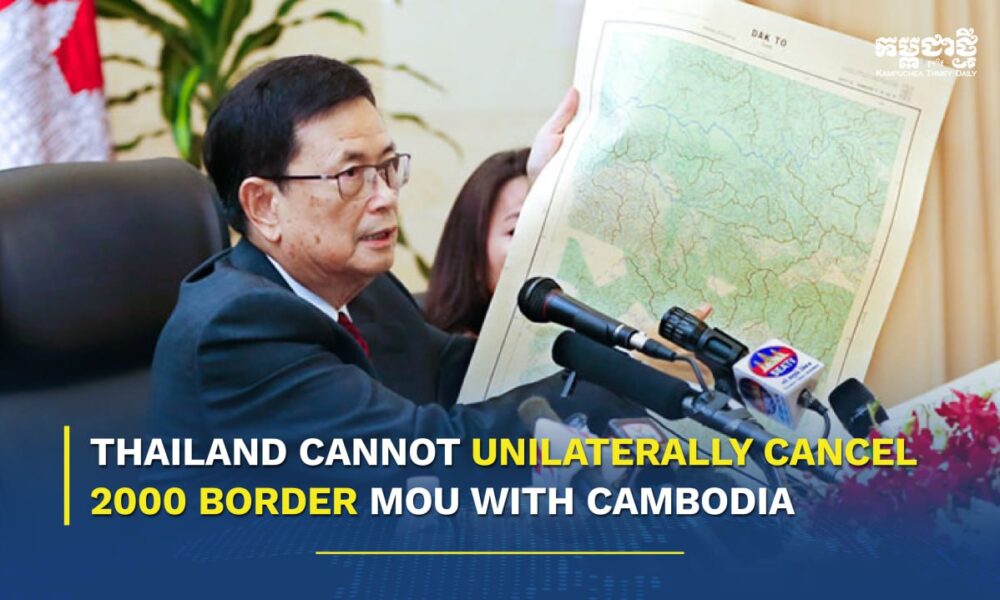
Legal experts warn Thailand cannot unilaterally cancel 2000 border MOU with Cambodia, citing international law violations
PHNOM PENH, Cambodia (Oct.02, 2025) — Prominent legal experts and scholars have warned that Thailand cannot unilaterally withdraw from the 2000 Memorandum of Understanding (MOU) on border demarcation with Cambodia, stating that such action would violate international law and risk serious diplomatic consequences.

Signed on June 14, 2000, the Cambodia–Thailand MOU was established to facilitate peaceful land border demarcation and promote bilateral cooperation. The agreement is registered with the United Nations, giving it the legal status of a binding international treaty.
“Thailand cannot simply cancel the 2000 MOU on its own,” said Sam Oeun Sok, a Cambodian legal expert. “International agreements between sovereign states, even if labeled as MOUs, are binding under international law. This is not a private contract—violations carry consequences.”
Sok emphasized that unilateral withdrawal would breach Thailand’s international obligations and could trigger condemnation or even sanctions. “Powerful countries may sometimes avoid penalties, but smaller nations face reputational and economic risks when they disregard treaty commitments,” he said.
Kin Phea, Director-General of the International Relations Institute at the Royal Academy of Cambodia, echoed these concerns. He noted that both the 2000 and 2001 MOUs are registered with the UN and governed by the 1969 Vienna Convention on the Law of Treaties.
“Unilateral withdrawal is not permitted unless explicitly stated in the treaty itself, which the MOU does not allow,” Phea said.
He warned that if Thailand proceeds with cancellation, Cambodia would have legal grounds to bring the case before the International Court of Justice (ICJ) and seek UN intervention.
“Such action would not only violate international law but also damage Thailand’s reputation and portray it as a country that disregards international norms,” he added.
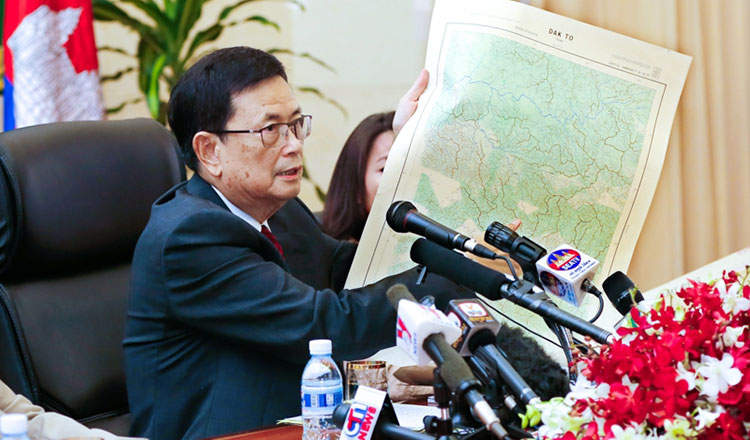
Phea also explained that the 2000 MOU is rooted in historical treaties, including the Franco-Siamese agreements of 1904 and 1907, and provides for demarcation based on a 1:200,000 scale map accepted by both sides.
He cautioned that canceling the MOU could undo years of diplomatic progress and jeopardize Cambodia’s territorial integrity, especially in overlapping maritime zones where oil and gas exploration is planned.
“Worse still,” Phea said, “Thailand’s use of unilateral maps could reignite border tensions and threaten regional peace and stability.”
Seng Dina, spokesperson for Cambodia’s Ministry of Justice, affirmed that the MOU remains valid until border demarcation is fully completed.
He cited Article 102 of the UN Charter and ICJ jurisprudence, including the Somalia v. Kenya case, to confirm the MOU’s binding nature.
“The MOU cannot be unilaterally terminated,” Dina said. “It remains in force until its objectives are fulfilled, and any amendment or cancellation must be mutually agreed.”








-
 National2 months ago
Cambodia Expands Free ID Services While Introducing Clear Fee Structure for Administrative Documents
-
 National3 weeks ago
Cambodia proposes trilateral anti‑crime liaison mechanism with Laos, Vietnam
-
 National2 weeks ago
PM Hun Manet to visit China as trade surges and investment deepens
-

 National2 weeks ago
Cambodia says four soldiers injured in border blast, investigation launched
-
 National1 month ago
Samdech Techo Hun Sen Says Cambodia Can Meet Defence Needs Through Domestic Production
-

 National2 weeks ago
Cambodia opens new distribution hub to expand market access for local businesses
-
 Opinion2 months ago
From Connectivity to Resilience: How Japan’s Strategic Shift Could Transform Cambodia’s Next Development Phase
-
 Economy2 months ago
Cambodia Welcomes 1 Million Tourists in Q1, But Arrivals Fall Sharply Amid Regional Pressures