Opinion
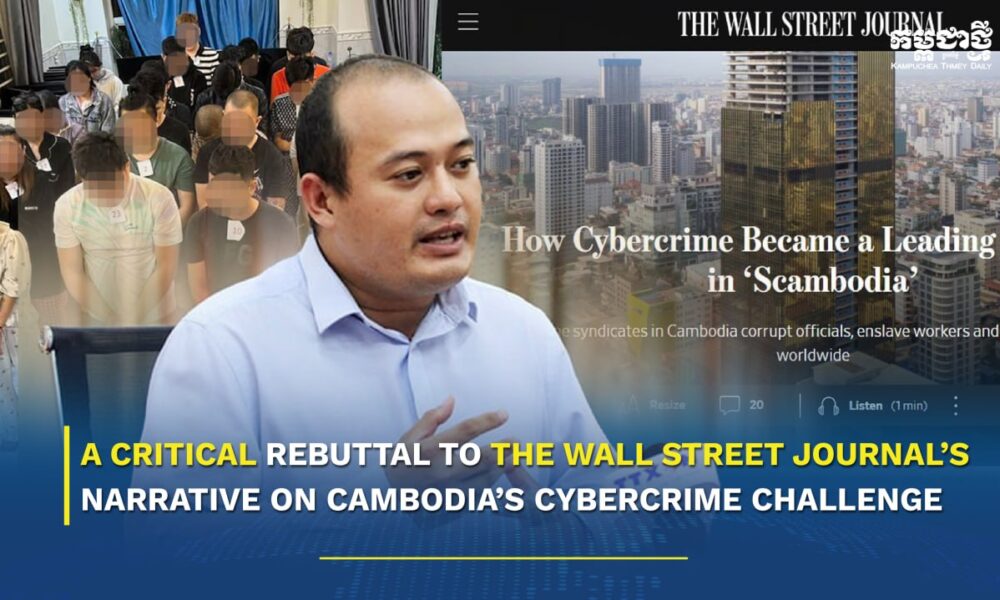
A Critical Rebuttal to The Wall Street Journal’s Narrative on Cambodia’s Cybercrime Challenge
By: THONG MENGDAVID-Geopolitical and International Security Analyst
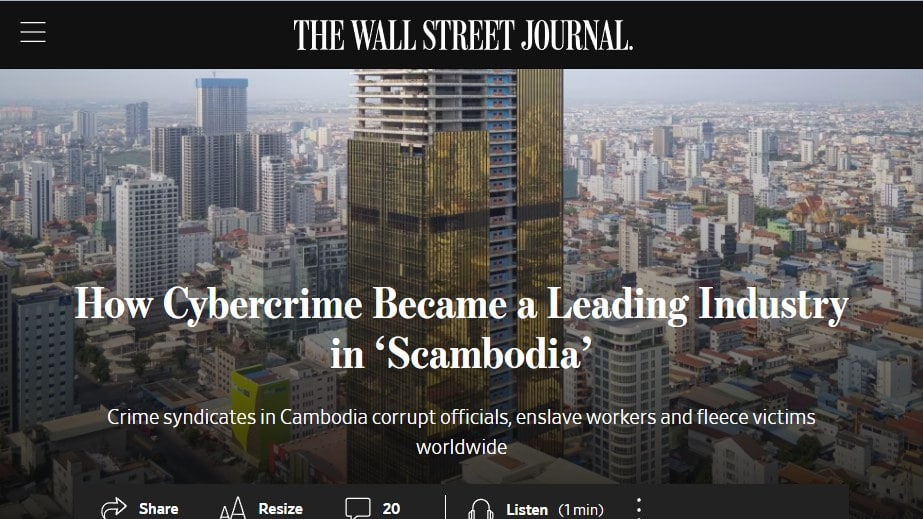
PHNOM PENH, 27 April, 2026 (KPT)- The recent article written by The Wall Street Journal portraying Cambodia under the label “Scambodia” reflects a troubling departure from balanced journalism toward sensational framing.
While the rise of cybercrime in Southeast Asia is well-documented, the article’s rhetorical choices and evidentiary selectivity risk distorting a complex transnational issue into a simplified national stigma.
This is particularly concerning given that even the article itself acknowledges that scam networks are largely operated by transnational syndicates, often linked to Chinese criminal groups, rather than being uniquely Cambodian in origin or structure (The Wall Street Journal).
The ethical issue lies not in reporting on cybercrime, but in generalizing criminal ecosystems into a national identity. Estimates cited in multiple international reports suggest that scam operations across Cambodia may involve over 100,000–150,000 trafficked workers, often victims themselves rather than perpetrators (CSIS).
By collapsing these realities into a stigmatizing label, the reporting overlooks the distinction between state, society, and transnational criminal networks, thereby undermining journalistic standards of proportionality and accuracy.
Equally problematic is the article’s selective use of evidence and omission of state responses. Since 2025, the Royal Government of Cambodia has significantly escalated its countermeasures across the country.
In February 2025, it formally established the Commission for Combatting Online Scams, tasked with prevention, suppression, and enforcement against cybercrime networks (pressocm.gov.kh).
This institutional mechanism has been accompanied by large-scale enforcement actions. By early 2026, authorities had shut down at least 200 suspected scam sites and detained more than 3,500 individuals in nationwide crackdowns (cambojanews.com).
Furthermore, official figures indicate that over 30,000 suspected foreign scammers were deported, while more than 210,000 individuals voluntarily left Cambodia amid intensified enforcement measures (vietnamnews.vn). These are not symbolic actions but reflect a systematic, state-led response to dismantle cybercrime infrastructure.
In addition, Cambodia has strengthened its legal and policy frameworks. The government has introduced new legislation targeting cyber fraud and expanded enforcement under anti-trafficking initiatives, which saw 197 cases prosecuted in 2024 alone, with a notable increase in deportations of foreign offenders (Business and Human Rights Centre).
Cambodia has also aligned itself with regional mechanisms such as the emerging ASEAN-led frameworks on combating online scams, reflecting a commitment to multilateral solutions.
International cooperation has further intensified, including joint efforts with partners such as China, the United States, the United Kingdom, and South Korea in intelligence-sharing, financial tracking, and victim repatriation, an essential component given the cross-border nature of these crimes.

Despite these documented efforts, the The Wall Street Journal article gives limited attention to such developments, instead emphasizing allegations and high-end estimates of illicit revenues.
For instance, while figures suggesting that scam revenues could reach $12–19 billion annually are widely circulated, they are derived from regional watchdog estimates rather than confirmed national accounts, and often lack methodological transparency (cambojanews.com).
The absence of scrutiny toward these figures’ contrasts sharply with the article’s readiness to adopt a definitive and stigmatizing narrative.
Moreover, the article raises questions of choosing Cambodia. Cybercrime networks are widely recognized to operate across multiple jurisdictions in Southeast Asia, including border regions of Myanmar and transit hubs linked to Thailand.
Reports indicate that scam compounds and financial networks extend across the Thailand–Myanmar border and involve cross-border money laundering channels (Business and Human Rights Centre).
Global estimates further show that over 200,000 individuals have been trafficked into scam operations across Southeast Asia, not limited to Cambodia alone (WIRED).
Yet, the narrative focus remains disproportionately centered on Cambodia, with no equivalent labeling applied to other affected countries. This asymmetry suggests a framing that prioritizes headline impact over regional analytical balance.
It is also important to note that even critical reports acknowledge ongoing enforcement and crackdowns by Cambodian authorities, including raids, rescues, and dismantling of major compounds (The Wall Street Journal).
The persistence of cybercrime, therefore, should not be interpreted as state endorsement or hide those operation, but rather as evidence of the difficulty of combating highly adaptive transnational criminal networks, a challenge faced by governments worldwide, not just only Cambodia.
In conclusion, while cybercrime in Cambodia is a serious issue requiring sustained attention, the characterization of the country as “Scambodia” represents a reductionist and ethically questionable framing.
A more credible journalistic approach would situate Cambodia as a victim within the broader regional ecosystem of cybercrime, critically assess both allegations and enforcement efforts, and avoid language that conflates criminal activity with national identity.
In an era where information shapes public’s perception on geopolitical, accuracy, transparency, equity and topic selection for the report must remain the cornerstone of responsible reporting.







-

 National1 month ago
Cambodia Expands Free ID Services While Introducing Clear Fee Structure for Administrative Documents
-

 National3 weeks ago
Cambodia proposes trilateral anti‑crime liaison mechanism with Laos, Vietnam
-

 National2 weeks ago
PM Hun Manet to visit China as trade surges and investment deepens
-

 National2 weeks ago
Cambodia says four soldiers injured in border blast, investigation launched
-

 National1 month ago
Samdech Techo Hun Sen Says Cambodia Can Meet Defence Needs Through Domestic Production
-

 National2 weeks ago
Cambodia opens new distribution hub to expand market access for local businesses
-
 Opinion2 months ago
From Connectivity to Resilience: How Japan’s Strategic Shift Could Transform Cambodia’s Next Development Phase
-

 Economy2 months ago
Cambodia Welcomes 1 Million Tourists in Q1, But Arrivals Fall Sharply Amid Regional Pressures