Opinion
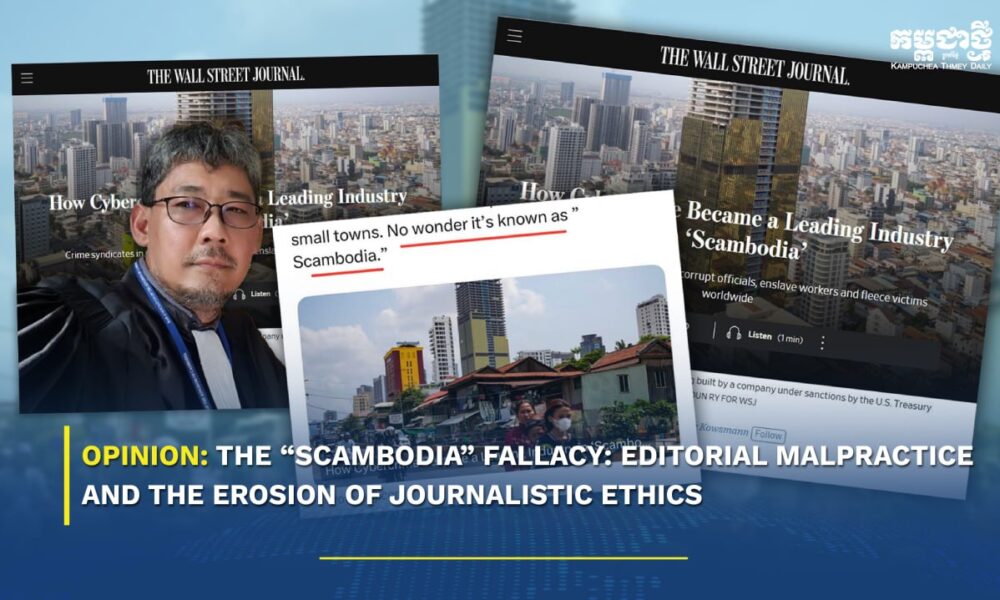
Opinion: The “Scambodia” Fallacy: Editorial Malpractice and the Erosion of Journalistic Ethics
PHNOM PENH, April 21, 2026 (KPT) — I believe in—and respect—freedom of the press. A free media is a mirror of society. But when that freedom operates without ethical restraint, it does not reflect reality—it distorts it. And when journalism replaces accuracy with sensationalism, it ceases to serve the public and begins to harm it.
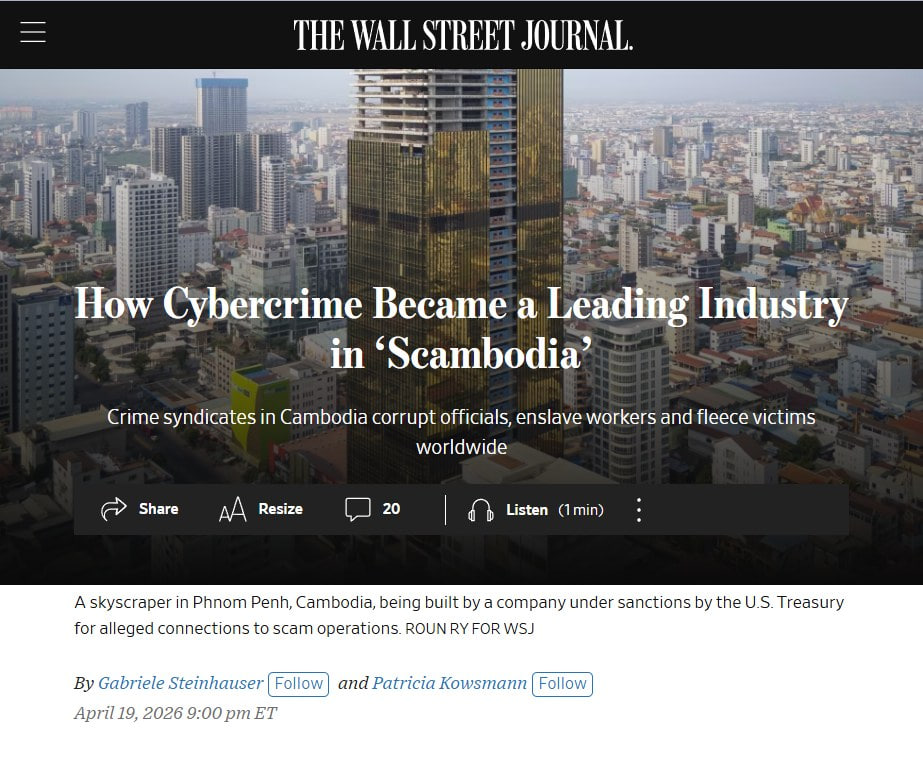
This failure is starkly visible in recentinternational reporting—most notably by The Wall Street Journal—that labels an entire nation, Cambodia, with the derogatory moniker “Scambodia.”
The Verdict on Reductive Reporting
For a publication that positions itself as a global standard in financial journalism, the use of such a term represents a serious ethical lapse. In the legal profession, language is never casual. Words define responsibility, shape perception, and carry consequences.
By resorting to a slur to frame a complex issue involving human trafficking and transnational cybercrime, The Wall Street Journal departs from the very principles it claims to uphold: precision, objectivity, and nuance. This is not merely a stylistic misjudgment. It is editorial malpractice.
When a respected outlet adopts the language of caricature, it signals that it values attention over accuracy—trading credibility for engagement. That is not investigative journalism. It is narrative distortion.
More Than a Misnomer: The Weight of Words
Reducing a sovereign nation of 17 million people to a pun is not only reductive—it is intellectually dishonest. The term “Scambodia” operates as a rhetorical shortcut, bypassing complexity in favor of emotional impact.
The reality is more complicated. The cybercrime networks in question are transnational by design. They operate across borders, often driven by foreign criminal syndicates and sustained through regional vulnerabilities—from Myanmar to Laos to Thailand.
To localize a global system into a single label is to misrepresent the problem itself. It shifts attention from the network to the geography, from the system to the symbol.
The Litmus Test of Good Faith
If journalism is to be taken seriously as a “fourth estate,” it must meet the standards of good-faith reporting.
Measured against those standards, the “Scambodia” framing fails on three fronts:
Distinction. Credible reporting separates a nation, its people, and the criminal actors operating within its borders. This label collapses all three into one, implying that the country itself is synonymous with crime.
Context. Serious journalism explains systems—financial flows, trafficking routes, and the role of foreign actors. A sensational headline erases that complexity, leaving readers with a caricature rather than an understanding.
Minimization of Harm. Ethical journalism requires awareness of consequences. Indiscriminate labeling damages a country’s reputation, affecting tourism, investment, and public morale. When nuance is known but discarded for effect, the objective is no longer public understanding—it is engagement.
Beyond the Click: The Cost of Sensationalism
For a publication of global influence, such language is not harmless. It is effective—precisely because it is provocative. But effectiveness without responsibility is dangerous.
This is not simply an editorial misstep. It is reputational harm at scale.
By framing Cambodia through a reductive label, the publication risks undermining the very international cooperation needed to address transnational crime. It alienates stakeholders, reinforces simplistic narratives, and reduces complex regional dynamics into a binary of blame.
A Call for Institutional Accountability
Cambodia therefore has both a legitimate grievance and a principled basis to respond. Defending national dignity against reductive and harmful portrayals is not censorship—it is accountability.
A formal request for clarification or correction is not an attempt to silence the press. It is a demand that the press meet its own standards. It requires editorial boards to justify not only the facts they report, but the way they frame them.
If journalism seeks to hold power accountable, it must itself be accountable for the accuracy, fairness, and impact of its language.
Reclaiming Truth in the Age of Caricature
Cambodia does not deny the existence of the problem. It is actively confronting it. But transnational cybercrime cannot be addressed through caricature—it requires cooperation, precision, and shared responsibility.
If global media genuinely seeks solutions, it must move beyond sensational labels and toward rigorous, contextual reporting—reporting that reflects the complexity of the issue rather than obscuring it.
Anything less is not accountability. It is distortion.
The world does not need more provocative headlines. It needs journalism with the discipline to resist them—and the integrity to tell the harder truth.
This opinion article is written by Panhavuth Long, Attorney-at-Law. The views expressed are solely those of the author and do not reflect the position of KPT English







-
 National1 month ago
Poll Finds Strong Cambodian Support for Closer China Ties
-

 Economy2 months ago
Cambodia Moves to Boost Green Economy with $30 Million Climate Financing Deal
-

 National2 months ago
Cambodia Condemns ‘Scambodia’ Label in Wall Street Journal Report
-

 Economy1 month ago
Cambodia Bans Prize Promotions on Beer and Energy Drinks to Level Playing Field
-
 Opinion1 month ago
Vienna Convention on the Law of Treaties (VCLT)’s ruling over the MoU 2001 Cancellation by Thailand against Cambodian Maritime Territories
-

 Economy1 month ago
Cambodia Caps Fuel Price Rise as Global Oil Surge Hits Domestic Market
-
 Politics2 months ago
Cambodian Embassy in France Rejects ‘Politicization’ Claims, Affirms Neutral Role
-

 Politics2 months ago
Cambodia urges Thailand to uphold border deal, joint commission ready to work