Opinion
From Cambodia to the World: Tackling Online Scams Requires Global Accountability
Cambodia is frequently portrayed internationally as a hub for online scams. This perception oversimplifies a complex reality: Cambodia is also a vulnerable target of transnational networks that exploit regulatory gaps, digital platforms, and cross-border financial systems.
Online scams operate globally, and no single country controls—or fully sees—the entire chain. Assigning blame to one country alone misleads the public and undermines coordinated efforts to dismantle these criminal networks.
As a Cambodian lawyer familiar with the country’s legal and enforcement frameworks, I can attest that Cambodia has made progress in investigating and apprehending scammers, often in close cooperation with international partners.

Yet the broader truth is that these networks thrive because of gaps in global oversight, delayed enforcement, and selective accountability across multiple jurisdictions. Understanding this distinction is critical for effective policy, enforcement, and public perception.
Online Scams Are Borderless
Modern online scams are designed to cross borders. Recruitment, victim targeting, financial routing, asset accumulation, and platform use occur in multiple jurisdictions. Criminals exploit regulatory differences, weak oversight, and fragmented enforcement. No single country fully observes—or is solely responsible for—the entire network.
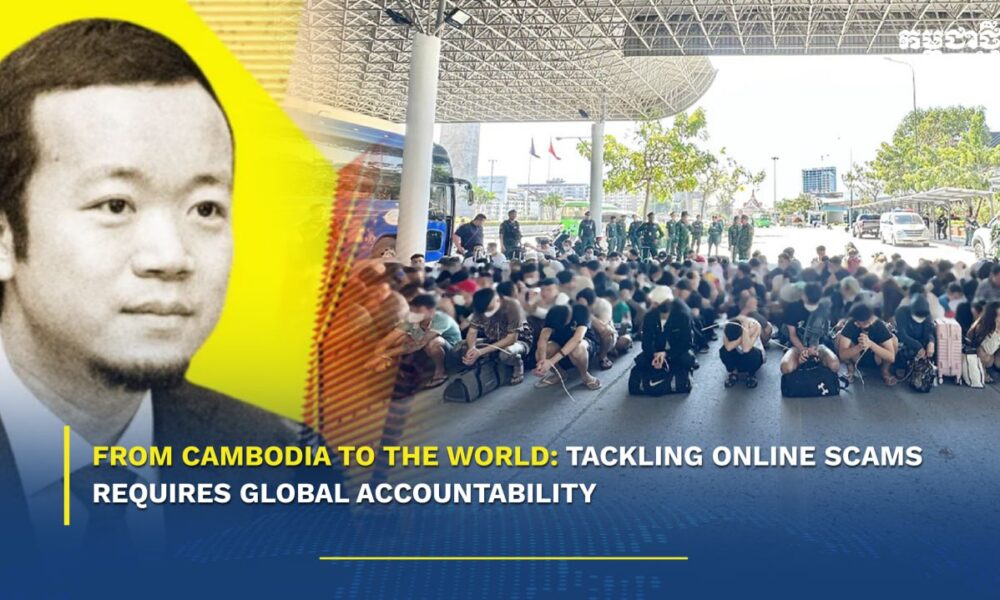
The Chen Zhi Case: A Global Network
The case of Chen Zhi illustrates this clearly. Reports indicate his alleged network operated across numerous countries, with financial flows, corporate structures, digital platforms, and assets spanning the U.S., U.K., Singapore, Hong Kong, Taiwan, Thailand, South Korea, China, and beyond.
Chen Zhi reportedly held multiple passports, enabling him to move, invest, and operate internationally—possible only with access to foreign financial systems, corporate registries, property markets, and digital platforms.

Why Chen Zhi Could Operate Globally
Chen Zhi’s network thrived due to systemic factors across jurisdictions
Fragmented Regulation: Anti-money-laundering and corporate transparency rules differ widely; flagged funds in one country may be invisible or legal in another.
Corporate and Financial Infrastructure: Shell companies and trusts in Singapore, Hong Kong, and the U.K. allow foreign investors to acquire property with minimal disclosure.
Cryptocurrency and Digital Finance
Fintech and crypto platforms enabled rapid, opaque transfers, converting digital wealth into real assets while masking origins.
Multiple Nationalities: Passports allowed legal investment abroad, often via intermediaries or corporate entities.
Delayed Enforcement: Many jurisdictions act only after sanctions, media exposure, or external pressure.
Open Economies: Investment-friendly regimes facilitated integration of illicit proceeds into legitimate markets.
Chen Zhi’s reach was not a reflection of one country’s failure—it was a systemic global vulnerability.
Cambodia Is Not the Enabler
It must be emphasized that Cambodia did not enable Chen Zhi’s scams. The network thrived due to digital platforms, financial systems, corporate structures, and networks spanning multiple countries, combined with failures in global accountability. While some operations occurred partly in Cambodia, the real enablers were international systems that facilitated recruitment, fund transfers, and
asset accumulation largely unchecked. Cambodia was a vulnerable target and cooperative partner, not a sponsor.
The Elephant in the Room
Cambodia actively cooperated with Chinese authorities and other relevant countries to apprehend Chen Zhi. The real “elephant in the room” is that Chen Zhi could operate across multiple countries, use corporate and financial structures abroad, and acquire luxury properties in Singapore, Hong Kong, and the U.K.—often without scrutiny—until sanctions or external pressure intervened. This systemic gap, not Cambodia’s vulnerability, enabled the network to thrive.
Global Enforcement Actions
Following international scrutiny, several jurisdictions acted:
U.S. and U.K. sanctions froze assets, including cryptocurrency and high-value properties.
Singapore seized over US$100 million.
Hong Kong froze billions in suspected proceeds.
Thailand and Taiwan undertook asset seizures and investigations.
South Korea imposed sanctions on networks affecting Korean nationals.
China, with Cambodian cooperation, pursued criminal proceedings after Chen Zhi’s arrest.
These actions confirm that the network—and its enabling environment—was global. Decisive enforcement often occurred only after external pressure, revealing a de facto collusion: gaps in regulation, delayed enforcement, and selective action allowed transnational networks to profit and expand with impunity.
Platforms, Financial Systems, and Responsibility
Illicit proceeds moved through banks, fintech firms, crypto exchanges, and corporate vehicles, then were converted into real estate, businesses, and luxury assets. Digital platforms—social media, messaging services, and payment systems—were essential in committing scams and laundering proceeds. Yet accountability across these platforms remains fragmented.
When jurisdictions claim ignorance until external intervention, it mirrors arguments often applied unfairly to Cambodia. Standards of accountability cannot be selective.
Cambodia: Progress, Vulnerability, and the Need for More
Cambodia has made significant progress in investigating and apprehending online scammers, including cooperation with relevant countries and Chinese authorities on cases such as Chen Zhi. Authorities have also repatriated individuals who were trafficked or coerced to participate in scams to their respective countries, and pursued prosecutions against major leaders of domestic scam networks.
Cambodia has strengthened its legal and regulatory framework, updating cybercrime and anti-money-laundering laws, and engaged with ASEAN partners, Interpol, and UNODC to improve cross-border enforcement and intelligence sharing. These efforts demonstrate Cambodia’s serious engagement, commitment to enforcement, and willingness to tackle complex networks while protecting victims.
Yet progress does not absolve Cambodia. Scam centers still exist on its soil, and authorities must strengthen investigations, enforce the law, and crack down decisively. Cambodia should prioritize quality over quantity: rounding up individuals produces statistics but does little to dismantle networks, recover illicit assets, or prevent future scams. Intelligence-driven crackdowns, targeting network organizers and coordinated internationally, will better protect victims and deter criminals.
Why Selective Blame Weakens Enforcement
Cambodia cooperated actively, yet it remains central in the blame narrative, while countries where funds transited, assets accumulated, companies were
registered, and platforms operated often escape scrutiny. Assigning primary responsibility solely to the country of arrest—while minimizing the role of financial hubs, asset-hosting jurisdictions, and platforms—produces selective accountability, not justice.
Conclusion: Toward Coordinated Global Accountability
The Chen Zhi case demonstrates that online scams are not just a Cambodian problem—they are a global challenge. Cambodia has cooperated and made progress, but it cannot shoulder responsibility alone. Other jurisdictions—where assets, platforms, or corporate structures existed—also bear responsibility. Gaps in regulation, delayed enforcement, and selective action reveal a de facto collusion, enabling transnational networks to profit until external pressure intervenes.
Cambodia can and should strengthen intelligence-driven crackdowns, while the international community must work hand-in-hand to dismantle networks at their source. At the same time, individuals are entitled to legal representation and due process under Cambodian and international law. Effective justice requires both vigilant enforcement and fair defense.
Only through coordinated global accountability, addressing domestic vulnerabilities and international enablers alike, can victims be protected, illicit assets recovered, and future scams prevented.
Panhavuth Long
A lawyer
PAN & Associates Law firm










-
 National2 months ago
Cambodia Expands Free ID Services While Introducing Clear Fee Structure for Administrative Documents
-
 National3 weeks ago
Cambodia proposes trilateral anti‑crime liaison mechanism with Laos, Vietnam
-

 National2 weeks ago
PM Hun Manet to visit China as trade surges and investment deepens
-

 National2 weeks ago
Cambodia says four soldiers injured in border blast, investigation launched
-

 National1 month ago
Samdech Techo Hun Sen Says Cambodia Can Meet Defence Needs Through Domestic Production
-

 National2 weeks ago
Cambodia opens new distribution hub to expand market access for local businesses
-
 Opinion2 months ago
From Connectivity to Resilience: How Japan’s Strategic Shift Could Transform Cambodia’s Next Development Phase
-

 Economy2 months ago
Cambodia Welcomes 1 Million Tourists in Q1, But Arrivals Fall Sharply Amid Regional Pressures